Contact center operations have never been simple, but today, they’re more complex than ever. Hybrid staffing models, volatile demand, tighter SLAs, higher customer expectations.
Yet, most Workforce Management (WFM) teams are still working in the same way they always have: watching dashboards, chasing anomalies, and reacting once performance starts to slip. In today’s environment, that reactive model simply doesn’t scale.
Visibility isn’t the Same as Control
Most WFM tools are excellent at showing what’s happening in the moment: when service levels start to dip, occupancy creeps up, adherence slips off plan.
But visibility alone doesn’t explain why it’s happening, what the downstream impact will be, or what action should be taken next. That burden falls to WFM managers and real-time analysts, who are left switching between dashboards, piecing together patterns, and weighing options while the clock keeps ticking. Too often, by the time the root cause is identified, the opportunity to prevent impact has already passed.
Why Reactive Operations No Longer Works
When demand changes minute-by-minute, reacting after performance drops is too late. A small forecasting gap can quickly turn into:
- Missed service levels
- Overworked agents
- Frustrated customers
And without early warning or clear guidance, teams are forced into firefighting mode, constantly responding to issues instead of preventing them. What’s missing isn’t more data, it’s understanding and direction.
Introducing Calabrio Predictive Actions
Calabrio Predictive Actions is designed to transform intraday management.
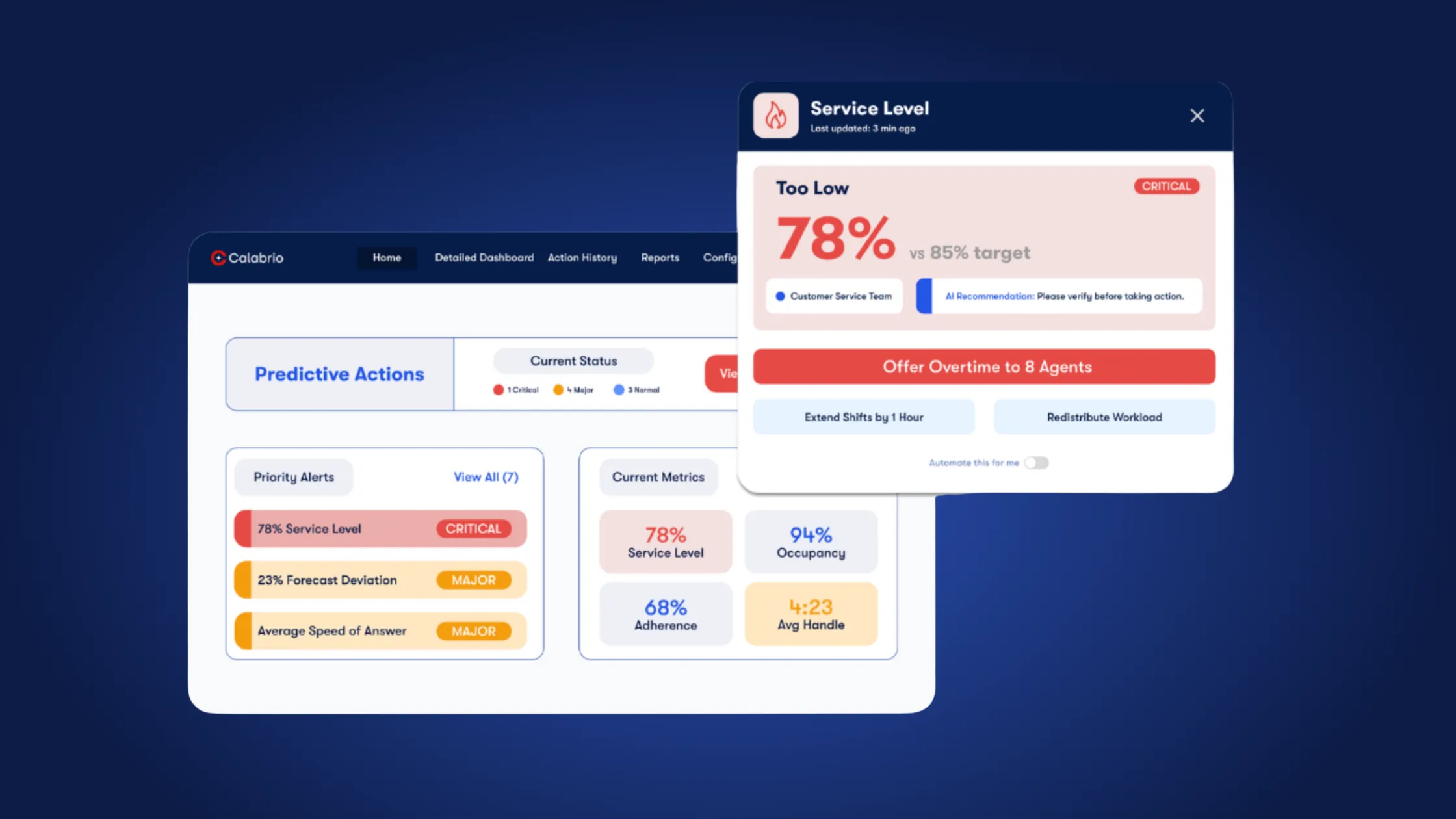
It’s an AI-powered assistant within Calabrio Workforce Intelligence that helps WFM managers and real-time analysts focus on what matters most, understand why it happens, and act before issues escalate.
Instead of monitoring multiple dashboards, Predictive Actions:
- Detects early warning signs across service level, occupancy, adherence, and forecast accuracy
- Explains the drivers behind KPI deviations
- Predicts the likely impact of emerging issues
- Prioritizes what needs attention now
- Recommends clear, practical actions to prevent disruption
For example, when a KPI starts to deviate, teams can simply ask, “Why is this happening?” Predictive Actions responds with clear explanations, such as understaffing in specific intervals, low schedule adherence, or unexpected volume spikes, before recommending the next best action.
In simple terms, it acts like a real-time coach, highlighting the issue, explaining the cause, and guiding the next best move.
One View That Turns Insight into Action
At the core of Predictive Actions is a unified view of intraday performance that brings clarity to complexity. Instead of juggling multiple alerts, dashboards, and metrics, teams are presented with a consolidated view of active issues, their level of criticality, the underlying drivers, and the actions most likely to have the greatest impact. This context enables faster, more confident decision-making in the moments that matter most.
Whether the right response is adjusting schedules and breaks, redistributing the workload, offering overtime, or triggering reforecasting, recommended actions are surfaced in real time, allowing teams to intervene before performance is affected rather than reacting after service levels have already declined.
Built for the Reality of Today’s Contact Centers
Predictive Actions has been designed around the most common, high-impact intraday challenges, including:
- Service level fluctuations: spotting dips or spikes early and stabilising performance
- Occupancy changes: preventing over-or under-utilisation before it becomes a problem
- Schedule adherence issues: identifying deviations and guiding fast intervention
- Forecast accuracy variance: closing gaps between forecast and actual demand
These are the moments where minutes matter, and where proactive action makes the biggest difference.
Turning Time Spent into Time Well Spent
For contact center leaders, the challenge is no longer simply maintaining service levels and customer experience, it’s doing so without increasing operational complexity or placing additional strain on already stretched teams. Highly skilled WFM managers and real-time analysts often spend a disproportionate amount of time monitoring dashboards and reacting to intraday changes, limiting their ability to focus on higher-value activities.
Predictive Actions helps shift that balance. By continuously detecting emerging issues and guiding teams toward the most impactful actions, it reduces the time spent on manual monitoring and accelerates response to intraday volatility. Decisions around staffing, workload distribution, and schedule adjustments become more consistent and data-driven, even as conditions change throughout the day.
The result is not fewer people, but better use of expert time. Instead of reacting to every fluctuation, teams can focus on optimizing performance and maintaining stability where it matters most. Predictive Actions doesn’t replace human judgement, it ensures that judgement is applied sooner, more effectively and with greater impact.
From Firefighting to Forward-Thinking
The future of Workforce Management isn’t reactive. It’s proactive, predictive, and driven by intelligence that doesn’t just surface issues, but explains them and helps teams stay ahead of them.
Predictive Actions marks a shift away from constant monitoring and toward confident, informed decision-making. By detecting issues early, anticipating their impact, and guiding the right actions at the right moment, it enables contact centers to operate with greater agility, resilience, and control, even as complexity continues to grow.
This is the power of Predictive Actions.
Predictive Actions is coming soon as part of Calabrio Workforce Intelligence!
Discover how Calabrio is redefining contact center operations and customer experiences, and see how the future of supervision is moving from reaction to readiness. Book a demo today!