AI agents have become a permanent part of customer service delivery. They answer questions, resolve issues, and increasingly decide whether a customer ever needs to speak to a human at all.
Yet, many organizations still evaluate performance as if humans are the only agents that matter.
That disconnect is showing up in familiar ways: rising handle times, declining sentiment, and QA scores that no longer seem to reflect the real customer experience. The issue is not that human agents are underperforming. It’s that AI agents are shaping customer outcomes earlier in the journey, before those interactions fall within the scope of traditional Quality Management
Handle Time Is No Longer a Human-Only Metric
AI is often introduced with the promise of efficiency. Simple contacts are meant to be resolved automatically, leaving humans to focus on higher-value work. In practice, many organizations see the opposite effect once automation scales.
When virtual agents misunderstand intent, delay escalation, or pass incomplete context to a human, the interaction becomes harder, not easier.
Customers repeat themselves. Emotions are already elevated. The human agent inherits a problem that is more complex than it needed to be, and handle time increases accordingly.
From a reporting perspective, this looks like a human productivity issue. In reality, it is an upstream automation issue that traditional metrics fail to expose.
Sentiment Is Set Before the Human Joins
Customer sentiment does not start at zero when an interaction is handed off. By the time a human agent says hello, the customer may already be frustrated by a looping bot, a failed self-service attempt, or a poorly timed escalation.
If sentiment analysis only looks at the human portion of the interaction, organizations systematically misread the cause of dissatisfaction. Agents appear to be driving negative sentiment when, in fact, they are absorbing it.
This is why many CX leaders struggle to reconcile falling sentiment scores with strong agent coaching and adherence. The emotional tone of the interaction was shaped earlier, outside the scope of most quality programs.
QA Programs Are Scoring Only Half the Journey
Quality Management has historically focused on human behavior: empathy, compliance, resolution, and tone. In a hybrid workforce, that model breaks down.
When virtual agents are measured in separate tools, or not measured at all, QA teams lose visibility into the first half of the customer journey. Human agents are then evaluated on outcomes they did not fully control, while automation operates outside the quality framework entirely.
Over time, this erodes confidence in QA scores as a reliable indicator of CX. Leaders sense something is missing, but struggle to articulate what.
Why a Unified Intelligence Layer Matters
The core issue is structural. Most enterprises run multi-vendor environments, combining CCaaS platforms with CRM, ITSM, and specialist AI agents. Each platform provides its own analytics, but none offers a neutral, end-to-end view of how humans and AI perform together.
This is the gap Omni Agent Intelligence, delivered within Calabrio ONE, is designed to address.
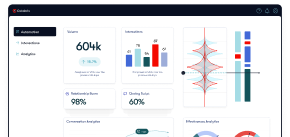
Rather than treating AI analytics as a side channel, Omni Agent Intelligence brings human and virtual agents into the same quality and intelligence model. Handle time, sentiment, and QA scores are evaluated across the full journey — bot to human, using consistent definitions and governance.
The value of this approach is not better dashboards, but better decisions. Leaders can see where automation genuinely reduces effort, where it creates downstream rework, and how virtual-agent behavior impacts human performance and customer outcomes.
A Shift in How Performance Is Governed
As AI agents become a permanent part of service delivery, organizations face a choice. They can continue optimizing humans in isolation, or they can evolve Quality Management into a control point for the entire hybrid workforce.
That shift requires seeing automation not as a separate system to monitor, but as part of the same quality program that governs human performance.
Because in modern customer service, handle time, sentiment, and QA scores are no longer owned by humans alone, and measuring them that way guarantees blind spots.
As AI agents become a permanent part of service delivery, the organizations that succeed will be those that govern humans and automation together, not in separate dashboards.
Learn how leading enterprises are using a unified quality and intelligence layer to understand the full customer journey, from virtual agent to human and beyond. Book a demo today!